
- Mon - Fri: 9.00 am - 8.00pm

...
...
Resources

Family Law
The Hon’ble Supreme Court in Dolly Rani v. Manish Kumar Chanchal reiterated that Hindu marriage is a samskara—a sacred bond. The Court invoked the Rig Veda: “With seven steps we have become friends.”
Hindu Marriage: A Sacred Bond and Legal Framework under the Hindu Marriage Act, 1955
June 9, 2025
The Hon’ble Supreme Court of India in Dolly Rani v. Manish Kumar Chanchal, decided on 19.04.2024, reiterated the time-honoured principle that a Hindu marriage is not merely a contract, but a samskara—a sacred and spiritual bond. The apex Court observed that “A Hindu marriage is a sacrament and has a sacred character. In the context of saptapadi in a Hindu marriage, according to Rig Veda, after completing the seventh step (saptapadi) the bridegroom says to his bride, “With seven steps we have become friends (sakha). May I attain to friendship with thee; may I not be separated from thy friendship”. A wife is considered to be half of oneself (ardhangini) but to be accepted with an identity of her own and to be a co-equal partner in the marriage. There is nothing like a “better-half” in a marriage but the spouses are equal halves in a marriage. In Hindu Law, as already noted, marriage is a sacrament or a samskara. It is the foundation for a new family.” The Court invoked the Rig Veda, which states that after the saptapadi (seven steps around the sacred fire), the bridegroom declares: “With seven steps we have become friends (sakha).” In this profound declaration lies the essence of Hindu marriage—equality, friendship, mutual respect, and spiritual unity. The wife is not a subordinate but an ardhangini (equal half), having an identity of her own and co-equal status in the institution of marriage.
Applicability of the Hindu Marriage Act, 1955
Section 2 of the Hindu Marriage Act, 1955, lays down the scope of its applicability. It extends to:
- Hindus by religion in any of its forms or developments, including followers of the Virashaiva, Lingayat, Brahmo, Prarthana, or Arya Samaj sects;
- Buddhists, Jains, and Sikhs by religion;
- Children, whether legitimate or illegitimate, where one or both parents belong to the aforementioned groups and the child is raised as part of the Hindu fold;
- Converts and reconverts to the Hindu, Buddhist, Jaina, or Sikh religions;
- Persons domiciled in India not governed by Muslim, Christian, Parsi, or Jewish law unless proven otherwise.
Conditions for a Valid Hindu Marriage
Section 5 of the Hindu Marriage Act lays down essential conditions for a valid marriage:
- Monogamy: Neither party should have a living spouse at the time of marriage.
- Mental Capacity: Both parties must be capable of giving valid consent.
- Age: The groom must be at least 21 years, and the bride at least 18 years old.
- Prohibited Degrees: The parties should not fall within the prohibited degree of relationship, unless allowed by custom.
- Sapinda Relationship: The parties must not be sapindas of each other, unless permitted by custom.
Failure to meet conditions (1), (4), or (5) renders the marriage void under Section 11, meaning it is legally non-existent from the outset.
Void and Voidable Marriages
Void Marriages: These are considered null and void ab initio. Examples include bigamous marriages or marriages within prohibited or sapinda relationships.
Voidable Marriages: These are valid until annulled by a court under Section 12. Grounds include:
- Impotency of a spouse,
- Consent obtained by force or fraud,
- Pregnancy of the bride by another person at the time of marriage.
Prohibited Degree and Sapinda Relationships
Prohibited Degrees of Relationship: These include relationships such as:
- Lineal ascendants/descendants (e.g., father-daughter),
- Siblings,
- Uncle-niece or aunt-nephew,
- Children of siblings.
Sapinda Relationship:
- Through the mother: up to the third generation (inclusive),
- Through the father: up to the fifth generation (inclusive),
- The individual is counted as the first generation in both lines.
Two persons are said to be sapindas if one is a lineal ascendant of the other within these limits, or they share a common ancestor within these generational bounds.
Landmark Judgments
Apart from Dolly Rani, the Supreme Court in Smt. Seema v. Ashwani Kumar (2006) observed that registration of marriage, though not a condition for validity, is important for evidentiary and administrative purposes. It directed state governments to frame rules for compulsory registration to safeguard women’s rights.
In essence, Hindu marriage, though governed by codified statutory law, continues to be deeply rooted in religious, cultural, and spiritual traditions. It promotes equality, respect, and companionship between spouses. However, the law ensures that such sacred bonds are not exploited and sets strict conditions, including prohibition on incestuous and sapinda unions, and provides remedies against fraudulent or coercive marriages. Through this holistic framework, the Act preserves the sanctity of the Hindu marriage while upholding individual rights and dignity. The Hindu Marriage Act, 1955, while preserving these ancient ideals, provides a clear legal framework to safeguard individual rights and ensure that this sacred bond remains just, equitable, and constitutionally sound in modern India.
Corporate Law
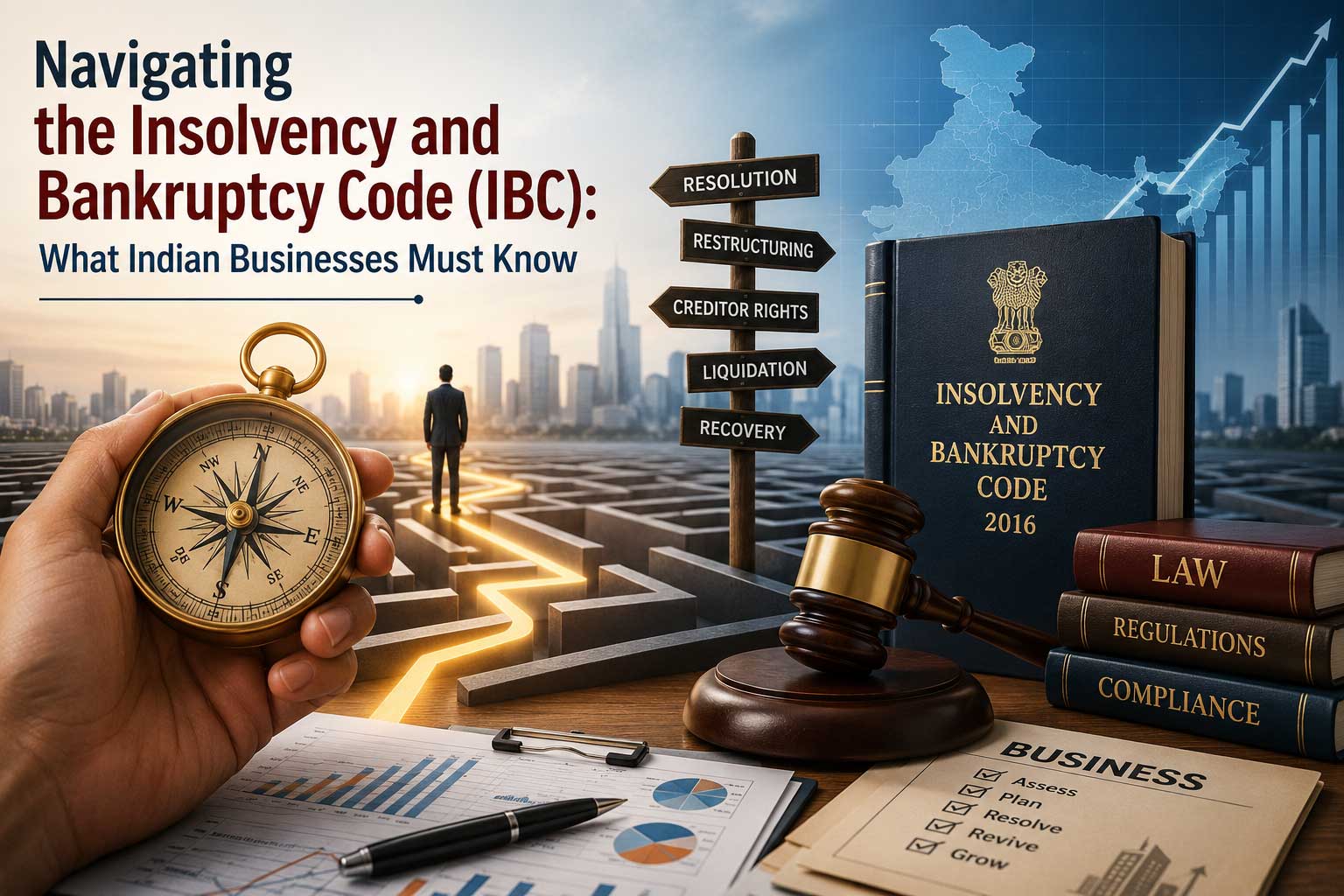
The IBC, 2016 is a transformative law that rewrote the rules of business rescue and debt resolution in India. It introduced a time-bound, unified process for insolvency.
Navigating the Insolvency and Bankruptcy Code (IBC): What Indian Businesses Must Know
April 21, 2025
India’s business landscape is as dynamic as it is challenging. For entrepreneurs and corporate leaders, the threat of financial distress is a reality that can strike at any time—from market downturns to unforeseen disruptions. Enter the Insolvency and Bankruptcy Code (IBC), 2016: a transformative law that has rewritten the rules of business rescue, creditor rights, and debt resolution in India. Whether you’re a startup founder, a seasoned CEO, or an investor, understanding the IBC is no longer optional—it’s essential for survival and growth in today’s economy.
In this article, we break down the essentials of the Insolvency and Bankruptcy Code (IBC) in simple, actionable terms for business owners, stakeholders, and professionals.
What is the Insolvency and Bankruptcy Code (IBC) and Why It Matters?
The IBC was introduced to address the long-standing problem of delayed and inefficient debt recovery in India. Before the IBC, recovering debts often took years and involved multiple overlapping laws. The Code unified these into a single, time-bound process.
Key goals of the IBC:
- Promote entrepreneurship
- Improve credit culture
- Protect interests of creditors
- Maximize value of distressed assets
- Facilitate timely resolution
Under the IBC, insolvency cases are handled by the National Company Law Tribunal (NCLT), which acts as the adjudicating authority.
Who can trigger the Insolvency and Bankruptcy Code (IBC) Process?
The IBC allows three types of applicants to initiate insolvency proceedings:
- Financial Creditors: Banks, NBFCs, and other lenders.
- Operational Creditors: Suppliers, vendors, and service providers.
- The Debtor Itself: Companies in distress can voluntarily seek resolution.
The threshold for initiating insolvency proceedings for corporate debtors stands at INR 1 crore (up from INR 1 Lakh earlier) for corporate debtors, personal guarantors, and partnerships. For MSMEs, a lower threshold may be prescribed through separate notifications under the pre-packaged insolvency framework.
The Corporate Insolvency Resolution Process (CIRP)
Here’s a simplified breakdown of the steps involved:
- Initiation: A creditor or debtor files an application before the National Company Law Tribunal (NCLT).
- Moratorium: Upon admission, the National Company Law Tribunal (NCLT) declares a moratorium, halting all recovery actions.
- Appointment of Interim Resolution Professional (IRP): An IRP is appointed to take over the management of the company.
- Claims and Committee of Creditors (CoC): Creditors submit their claims. A CoC is formed, mainly comprising financial creditors.
- Resolution Plan: A plan to revive the company is proposed and voted on by the Committee of Creditors (CoC).
- Approval/ Liquidation: If no plan is approved within 180-330 days, the company moves into liquidation.
Impact on Promoters, Directors and Guarantors
One of the most significant shifts under the Insolvency and Bankruptcy Code (IBC) is the limited role of promoters once Corporate Insolvency Resolution Process (CIRP) begins. Management is handed over to the IRP, and directors lose operational control.
Additionally:
- Personal guarantors can be held liable
- Fraudulent transactions can be reversed
- Wrongdoing promoters can be disqualified from submitting resolution plans
Pre-insolvency Risk Management
Preventive action can reduce risk and even avoid insolvency altogether.
Key steps include:
- Drafting enforceable contracts with clear payment terms
- Securing assets with collateral or guarantees
- Monitoring debtor health through regular checks
- Negotiating settlements early to avoid litigation
Insolvency and Bankruptcy Code (IBC) for MSMEs and Small Businesses
The IBC has been modified to include a simplified process for MSMEs under the pre-packaged insolvency resolution process (PPIRP). This allows small businesses to resolve financial distress without losing control of the company.
Benefits include:
- Faster resolution
- Debtor-in-possession model
- Lower legal costs
The pre-pack route is designed to support small businesses through financial recovery without significant disruption.
The Changing Future of IBC
The IBC is dynamic and constantly evolving, the key amendments and developments include:
- Cross-border insolvency framework: India is moving toward adopting the UNCITRAL Model Law, which will help manage insolvencies involving foreign creditors or assets located overseas.
- Faster resolution timelines: Emphasis has been placed on stricter adherence to the 330-day outer limit for CIRP completion.
- Real estate and homebuyer protections: Greater protections are being implemented for individual homebuyers as financial creditors.
- MSME-specific framework: Enhanced focus on PPIRP and easier access to insolvency remedies for MSMEs.
- Group insolvency: Steps are being taken to introduce group insolvency mechanisms to handle the resolution of interconnected companies under one group.
Practical Tips for Indian Businesses
To navigate financial stress or prepare for future uncertainties, Indian businesses can adopt these best practices:
- Review financials regularly: Early identification of cash flow issues helps prevent insolvency.
- Create a risk register: Track business, legal, and financial risks and update mitigation measures.
- Understand your creditor/debtor network: Know which vendors or clients could become liabilities.
- Stay updated with IBC changes: Track amendments and new notifications from Insolvency and Bankruptcy Board of India (IBBI) or Ministry of Corporate Affairs (MCA).
- Train internal teams: Ensure finance and legal teams are trained on key Insolvency and Bankruptcy Code (IBC) procedures.
- Build contingency plans: Prepare action plans for possible distress situations to ensure smoother handling.
- Foster transparent communication: Maintain open dialogue with key stakeholders to manage reputational risks.
Why it’s crucial to have a lawyer from the start?
Navigating insolvency law is not just about knowing the rules—it’s about applying them strategically. A corporate lawyer plays a critical role in:
- Assessing legal risks early
- Structuring contracts to avoid future disputes
- Representing the company before the NCLT
- Filing accurate claims and responses
- Reviewing resolution plans and protecting interests
Having legal support from the beginning ensures that the business is always a step ahead. Timely legal advice can prevent costly errors, reduce the chances of litigation, and lead to better financial outcomes.
Conclusion: Legal Strategy is Financial Strategy
The Insolvency and Bankruptcy Code (IBC) has already transformed India’s insolvency regime, but its journey is far from over. As India aims to become a global economic powerhouse, the IBC will remain central to ensuring financial stability, business revival, and investor confidence. With ongoing reforms and digitalization, businesses can expect an even more robust, transparent, and efficient insolvency ecosystem in the years ahead.
For Indian businesses, the message is clear: embrace the IBC, understand its workings, and be prepared. In a world where fortunes can change overnight, the IBC is both a shield and a sword—protecting value, enforcing discipline, and offering a second chance to those willing to adapt.
Ready to dive deeper? Stay tuned for more insights, case studies, and expert tips on navigating India’s evolving business laws.
Startup Advisory
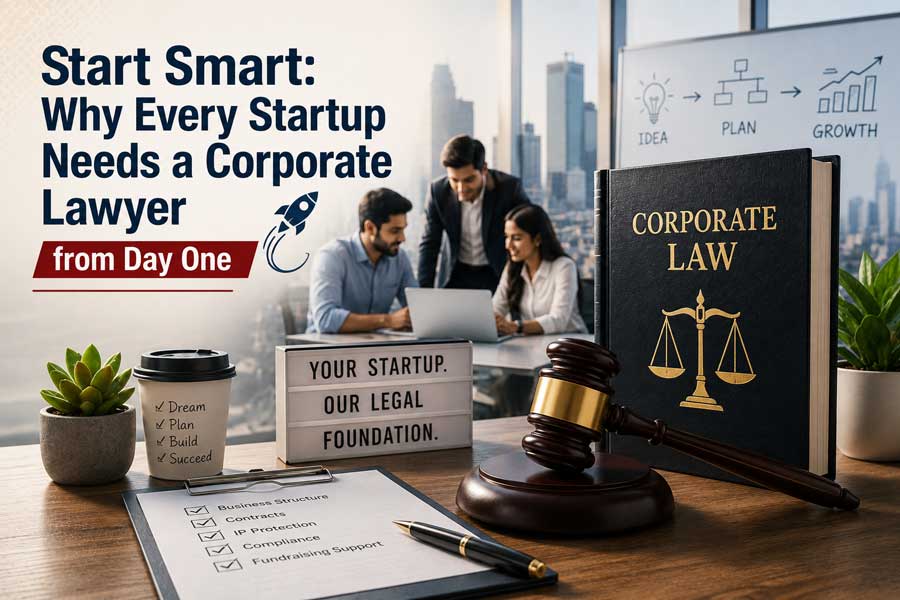
Starting a business is exciting, but legal foundations are often overlooked. A corporate lawyer helps with business structure, founders’ agreements, IP protection, and more.
Start Smart: Why Every Startup Needs a Corporate Lawyer from Day One
April 20, 2025
Starting a new business is exciting. You have a great idea, a motivated team, and dreams of success. But amidst the rush of building your product and finding customers, many startups overlook a crucial part of the journey: the legal foundation. This is where a corporate lawyer becomes not just helpful, but essential.
In this article, we will explain in simple terms why every startup should have a corporate lawyer from day one. Whether you’re just forming your company or raising funds, legal guidance can save you time, money, and trouble.
Choosing the Right Business Structure
The first step in your startup journey is choosing the right legal structure for your business. Should you form a Private Limited Company, a Limited Liability Partnership (LLP), or a sole proprietorship? Each structure has its own benefits and legal requirements.
A corporate lawyer will help you:
- Understand the pros and cons of each structure
- Choose the right one based on your goals
- Draft and file all the necessary documents with the Registrar of Companies (ROC)
Choosing the wrong structure can lead to tax problems, difficulties in raising funds, and even legal disputes in the future.
Drafting Strong Founders’ Agreements
When multiple people come together to start a company, it’s important to put things in writing. A Founders’ Agreement clearly lays out the roles, responsibilities, equity split, and what happens if someone wants to leave.
Without a proper agreement, even the best of friends can become legal enemies.
A corporate lawyer will:
- Help draft a legally binding Founders’ Agreement
- Include clauses for conflict resolution, vesting schedules, and exit strategies
- Ensure fair protection for all parties involved
Protecting Your Intellectual Property (IP)
Your startup’s ideas, branding, software, and inventions are valuable assets. If they’re not legally protected, someone else can copy or misuse them.
A corporate lawyer can:
- Register your trademark, logo, and brand name
- Help you file patents or copyrights, if needed
- Draft IP assignment agreements for employees and freelancers
IP protection builds trust with investors and clients and gives you legal power to stop misuse.
Ensuring Compliance with Laws
There are many laws a startup must follow—labour laws, tax laws, data privacy laws, and more. Missing even a small regulation can lead to penalties or cancellation of licenses.
A corporate lawyer will:
- Guide you on applicable laws based on your industry
- Help set up contracts and HR policies that follow the law
- Keep your company legally compliant as it grows
Fundraising and Investor Agreements
When it’s time to raise money, legal support becomes even more important. Term sheets, shareholder agreements, and compliance with securities laws can be complex.
A corporate lawyer can:
- Help negotiate favourable terms with investors
- Ensure your cap table is clean and accurate
- Draft and review all fundraising-related legal documents
Getting fund is hard enough. Legal mistakes can scare away potential investors.
Drafting Contracts That Protect You
Startups deal with many parties—vendors, clients, employees, freelancers, and partners. Every relationship should have a clear contract to avoid confusion or conflict.
A corporate lawyer will:
- Draft contracts that protect your business interests
- Review third-party contracts to spot red flags
- Ensure you have Non-Disclosure Agreements (NDAs) in place
Solid contracts mean fewer surprises and stronger business relationships.
Saving Time and Avoiding Costly Legal Problems
Many startups skip legal work thinking they’ll “do it later.” But later often becomes too late—when disputes arise or a big deal falls through.
Having a corporate lawyer from the beginning means:
- You can focus on growing your business while legal matters are handled professionally
- You avoid costly mistakes that could delay or even destroy your startup
- You build a strong legal foundation that supports future success
Creating Investor and Client Confidence
When investors or clients see that your startup is legally sound, they feel more confident working with you. A clean legal setup shows that you are serious, professional, and prepared.
A corporate lawyer helps you:
- Stay due diligence ready
- Maintain proper legal and financial records
- Build a trustworthy brand image
Scaling and Growth Strategies
As your startup begins to grow, strategic legal support becomes even more vital. Here’s how a corporate lawyer can support your scaling journey:
- Mergers and Acquisitions: If your startup is considering acquiring another company, merging with a competitor, or being acquired, a corporate lawyer can manage the legal complexities. They ensure compliance, protect your interests, and handle negotiations, contracts, and due diligence.
- International Expansion: Entering new markets comes with unfamiliar laws, regulations, and business norms. A corporate lawyer can help you navigate international legal systems, ensuring smooth expansion while minimizing risks and legal exposure.
Cost-Effective Legal Strategies for Startups
While the benefits of having a corporate lawyer are clear, startups must also be mindful of their budget. Fortunately, there are smart, cost-effective ways to manage legal needs without overspending. Here are some practical strategies:
- Prioritize legal needs: Work with your lawyer to identify and address the most critical legal issues first, such as company formation, IP protection, and compliance.
- Utilize alternative fee arrangements: Consider flat fees or monthly retainers instead of traditional hourly billing to get predictable and affordable legal support.
- Leverage technology: Use legal tech tools like document automation, contract templates, and compliance trackers to handle routine tasks efficiently.
- Educate yourself: Learn basic legal concepts to manage smaller legal tasks internally while reserving lawyer time for complex matters.
- Build a relationship: Develop a long-term relationship with a corporate lawyer who understands your business. This often leads to more tailored, quicker, and cost-effective service over time.
Conclusion: Legal Is Not Optional—It’s Foundational
Startups often focus on product, marketing, and funding—but forget that law is the backbone of business. From incorporation to exit, every stage has legal aspects that need expert handling.
Hiring a corporate lawyer from day one is not a cost—it’s an investment in your company’s future. It helps avoid trouble, attracts investors, and builds a strong business that lasts.
If you’re starting up or scaling up, our law firm is here to help you every step of the way. Reach out to us for a free consultation and let’s build your startup the right way, from day one.
Contact us today to get started!